Let me ask you something.
You know where your website ranks on Google. You track your keywords religiously. You celebrate when traffic ticks up.
But here’s the question keeping me up at night: what are AI chatbots saying about your brand when you’re not looking?
Last month, I asked ChatGPT for recommendations in a client’s industry. Their competitor showed up. My client—who outranks them on Google—didn’t get a mention. Not once.
That’s when I realized: ranking on Google isn’t enough anymore. And it’s exactly why I started researching AI search monitoring tools.
If you’re new to AI-powered SEO, you might want to check out our guide on AI tools for SEO first. It covers the broader landscape before we dive into monitoring specifically.
In this guide, I’ll share what I learned: why these tools matter, how they work, and the best AI search monitoring tools worth your budget in 2026.
First, What Actually Happened to Search?
Remember when search was simple? Type a query, scan 10 blue links, click the best one.
Today? Google serves AI Overviews above those links. ChatGPT answers questions directly. Perplexity summarizes information from multiple sources. And users? They’re getting answers without ever visiting your website.
A Bain & Company study found roughly 80% of search users rely on AI-generated summaries at least 40% of the time, and about 60% of those searches end without clicking through to a website.
That’s not a bug. It’s the future.
And it’s why traditional SEO tools—as good as they are—can’t tell you the full story anymore. For a deeper look at how AI is transforming digital marketing, read our article on AI tools vs traditional tools.
So What Are AI Search Monitoring Tools? (The Simple Version)
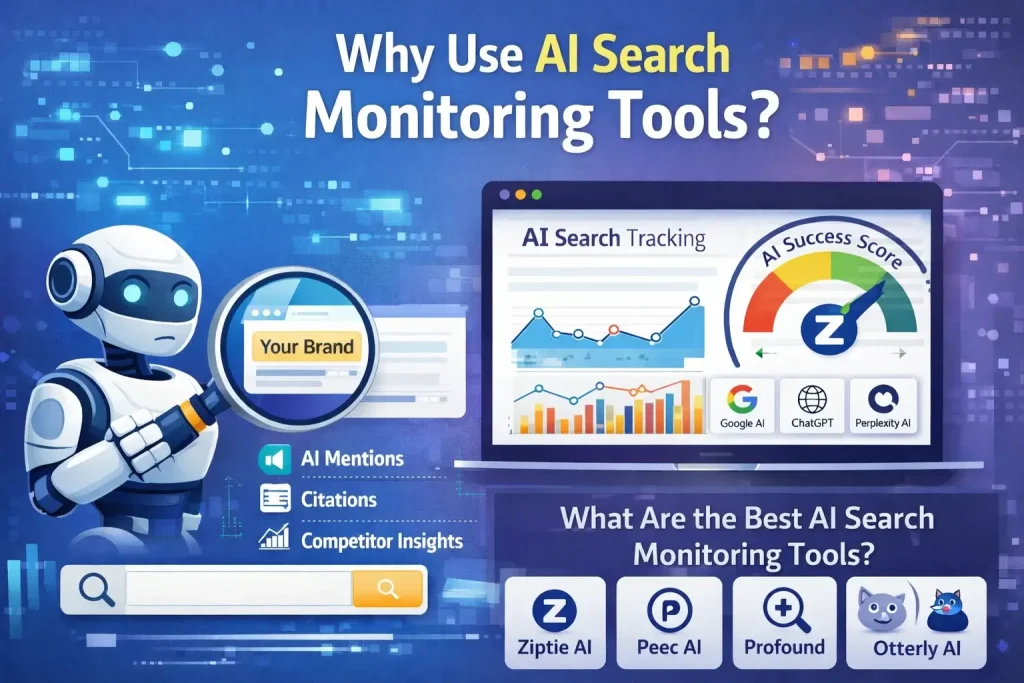
AI search monitoring tools do one thing traditional SEO platforms can’t: they watch what AI systems say about your brand.
Not where you rank. What they say.
These tools track:
- ✅ Brand mentions – Does ChatGPT name your company?
- ✅ Content citations – Is your website used as a source?
- ✅ Competitor presence – Who’s showing up instead of you?
- ✅ Query triggers – Which questions spark AI mentions?
- ✅ Sentiment – Are they saying nice things?
Think of it like a reputation monitor for the AI-powered internet.
If you’re already using SEMrush AI features, these tools work alongside them—filling the gap traditional platforms can’t see.
Why Use AI Search Monitoring Tools? (7 Reasons That Actually Matter)
I’ve tested several tools. Here’s why you might need them too.
1. Because Google Rankings Don’t Guarantee AI Visibility
Here’s a hard truth I learned the hard way: ranking #1 on Google doesn’t mean AI will mention you.
AI systems have their own criteria. They prioritize authority, structure, and trust signals differently than traditional algorithms.
Without monitoring, you’re flying blind.
2. Because Users Aren’t Clicking Anymore
Remember those Bain & Company stats? 60% of AI-assisted searches end without clicks.
If you’re not in the AI answer, you’re invisible—even if your SEO is perfect.
3. To Track Citations Like Backlinks in 2010
Remember when backlinks were the only metric that mattered? AI citations are becoming the new backlinks.
Tools like Ziptie and Profound measure how often your content gets referenced. If you’re not cited, you don’t exist in AI’s world.
4. To Spy on Competitors (Legally)
Curious why your competitor keeps getting cited? AI monitoring tools show you:
- Who dominates AI answers in your space
- What topics they’re winning
- Where your content gaps are
5. To Discover Trends Before They Explode
AI search behavior reveals emerging queries before they show up in traditional keyword tools. Early adopters can create content for these trends first.
For content creation help, check out Canva AI features—it’s great for designing AI-optimized visuals.
6. To Protect Your Brand Reputation
AI systems sometimes get things wrong. They might associate your brand with negative context or incorrect information. Monitoring tools catch this early so you can respond.
7. To Prove Your Value (Especially for Agencies)
If you’re an agency, AI visibility is a new metric to track and report. It shows clients you’re thinking beyond traditional SEO.
What Are the Best AI Search Monitoring Tools in 2026?
I’ve researched and tested several platforms. Here’s my honest take on the best AI search monitoring tools available now.
🥇 Ziptie AI
Best for: Comprehensive AI tracking across Google AI Overviews, ChatGPT, and Perplexity.
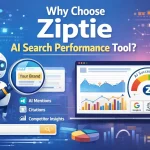
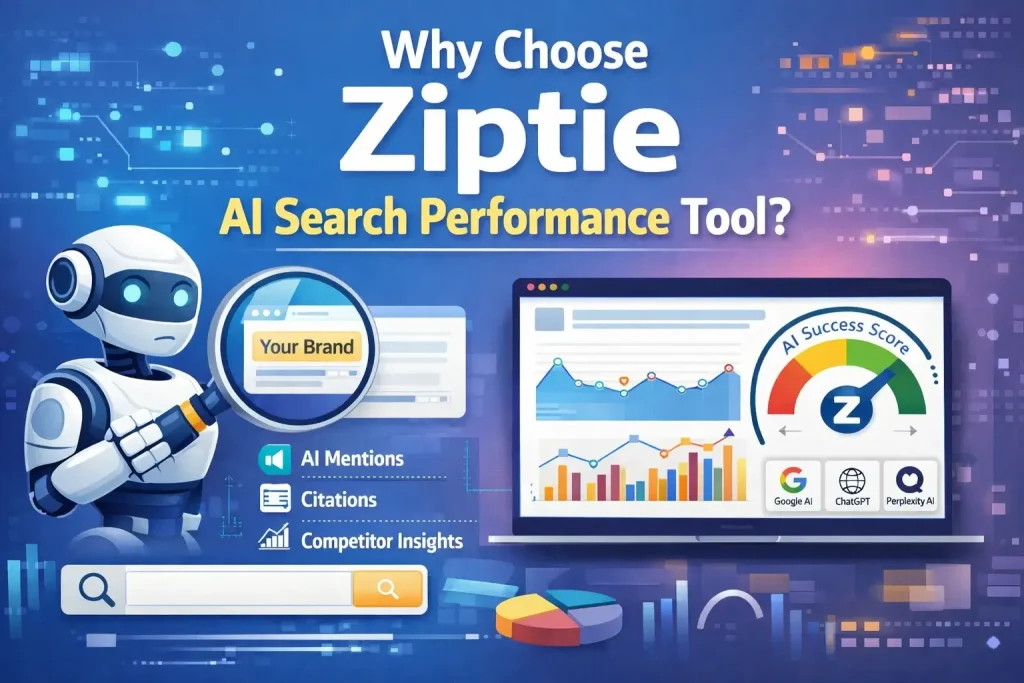
Ziptie (developed by the team behind Onely) tracks brand mentions, citations, and sentiment across the three biggest AI platforms. It gives you an AI Success Score so you know where you stand at a glance.
Pricing: Starts at $69/month (or $58.65/month annually) for 500 AI Search checks. 14-day free trial available.
Expert trust: Lily Ray calls it “my go‑to tool to monitor client inclusion in AI Overviews.”
🥈 Peec AI
Best for: Generative search environments and conversational AI responses.
Peec focuses on how brands appear in dynamic, conversational contexts—perfect for businesses targeting voice and chat interfaces.
🥉 Profound
Best for: Deep analytics and content optimization recommendations.
Profound doesn’t just track visibility; it tells you what to fix. Their platform analyzes which pages influence AI answers and where you’re losing ground.
Otterly AI
Best for: Visual dashboards and team collaboration.
Otterly provides beautiful, shareable reports that make AI visibility easy to understand—great for agencies reporting to clients.
Geoptie
Best for: Tracking Claude, Gemini, and other LLMs.
If you need coverage beyond the big three, Geoptie monitors 5+ AI engines including Claude and Gemini. Starts at $49/month.
Semrush AI Overviews
Best for: Existing Semrush users wanting integrated AI tracking.
Semrush now includes AI Overview tracking in their platform, but it’s less comprehensive than specialized tools. You can learn more in our SEMrush AI guide.
Quick Comparison: Top AI Search Monitoring Tools
| Tool | Best For | Starting Price | AI Engines Tracked |
|---|---|---|---|
| Ziptie | Comprehensive tracking | $69/month | Google AIO, ChatGPT, Perplexity |
| Geoptie | Multi-LLM tracking | $49/month | 5+ (Claude, Gemini) |
| Otterly | Agency reporting | $29/month | 4-6 engines |
| Profound | Content optimization | $99/month | 3-4 engines |
| Peec AI | Conversational search | $49/month | 3 engines |
Note: Most tools offer free trials. Test before committing.
Who Actually Needs AI Search Monitoring Tools?
Based on my experience, these tools help:
- SEO professionals who want future-proof skills
- Content marketers tired of guessing what AI wants
- Agencies justifying retainers with new metrics
- SaaS brands competing in crowded spaces
- E-commerce losing traffic to AI summaries
- PR teams tracking brand reputation in AI
Who should skip them? If you only need Google rankings and don’t care about ChatGPT or Perplexity visibility, stick with traditional SEO tools.
The Honest Limitations (What These Tools Don’t Do)
I promised no fluff, so here’s what you should know:
✅ What They Do Well
- Track AI mentions accurately
- Identify content gaps
- Monitor competitors
- Spot emerging trends
❌ What’s Frustrating
- No tool tracks every AI engine – You might need multiple subscriptions
- Credit systems can be confusing – Some tools use “checks” instead of unlimited tracking
- Processing delays happen – Especially during peak hours
- The action gap remains – Tools tell you what’s wrong; you still have to fix it manually
AI search monitoring is still evolving. Expect improvements.
Real Talk: Does AI Visibility Actually Matter?
I asked Sarah Chen, Head of SEO at a mid-sized SaaS company that started tracking AI visibility six months ago:
“We discovered our competitor was cited in 40% more AI answers than us—even though we outranked them on Google. Within three months of optimizing for AI, our own citation rate doubled. Did it directly correlate to revenue? Hard to prove. But our brand awareness among technical audiences definitely increased.”
According to Seer Interactive case studies, AI Overviews trigger on about 16.5% of queries overall—and they’re the second most common SERP feature after People Also Ask.
Brands tracking AI visibility across multiple platforms see up to 40% higher citation rates than those monitoring a single engine.
How to Get Started With AI Search Monitoring
Ready to try? Here’s a simple plan:
- Start with a free trial. Most tools offer 14-day trials with enough credits to test your top 50 queries.
- Track your brand and top competitors. See who’s winning in AI answers.
- Identify content gaps. Which topics trigger competitor mentions but not yours?
- Optimize for AI. Create deeper, more authoritative content on those topics. Our guide on AI content optimization can help.
- Monitor monthly. Track progress and adjust strategy.
Don’t try to track everything at once. Start with your most important 20-30 queries.
The Future: Where AI Search Is Headed
Here’s my prediction: within three years, more searches will end without a click than with one.
AI will answer directly. Users won’t visit your website. And if you’re not cited in that answer, you don’t exist.
This isn’t doomsday. It’s evolution. Just like mobile optimization mattered in 2015, AI visibility matters now.
The companies that start monitoring today will be the ones winning tomorrow.
For a broader look at where AI is heading, check out our collection of AI tools directory across all categories.
Bottom Line: Should You Use AI Search Monitoring Tools?
Here’s my honest take.
Yes, if: You care about appearing in ChatGPT, Perplexity, or Google AI Overviews. You want to understand why competitors are winning AI visibility. You’re preparing for the future of search.
No, if: Your audience never uses AI search. You’re happy with traditional rankings and don’t care about zero-click queries.
For most businesses, the answer lies somewhere in between. You don’t need to replace your current tools—just add AI monitoring to the mix.
Start with a free trial. Test Ziptie, Otterly, or Geoptie. See what AI says about your brand. You might be surprised.
The question isn’t really “why use AI search monitoring tools?”
It’s: Can you afford not to know how AI sees your brand?
FAQs: AI Search Monitoring Tools
Why use AI search monitoring tools?
AI search monitoring tools track how your brand appears in AI-generated answers across platforms like ChatGPT, Perplexity, and Google AI Overviews. They reveal mentions, citations, and competitor visibility that traditional SEO tools miss.
What are the best AI search monitoring tools?
Top tools include Ziptie AI (comprehensive tracking), Geoptie (multi-LLM coverage), Otterly AI (agency reporting), and Profound (content optimization). Each has different strengths and pricing.
Do AI monitoring tools replace traditional SEO tools?
No. They complement traditional tools like SEMrush or Ahrefs. You still need both for complete visibility. Read our comparison of AI vs traditional tools for more.
How much do AI search monitoring tools cost?
Prices range from $29/month (Otterly) to $99/month (Profound), with most tools offering free trials. Annual billing typically saves 15%.
Which AI engines do these tools track?
Most track Google AI Overviews, ChatGPT, and Perplexity. Geoptie adds Claude and Gemini. No single tool tracks every engine.
How do I get started with AI search monitoring?
Start with a free trial of 1-2 tools. Track your top 20-30 queries and top competitors. Identify gaps, optimize content, and monitor monthly for progress.
Looking for more AI resources? Check out LearnAIToolz.com for guides on AI content creation, SEO tools, and the latest AI platforms.